
How it all began?
In 1920, the lands of Anton Rohosynskyi, a landowner and breeder, were transferred to the peasants, and the sugar factories were nationalized. Petro Lyashenko was appointed as the director of the sugar factory in the village of Denykhivka. In 1922, a sugar plant was opened in Denykhivka, and the lands of the noble estates were transferred to this plant to provide it with raw materials, while agricultural producers received high-quality sugar beet seeds. Branches of the plant were established: Denykhivske, Dorodkivske, Pyatyhirske, and Odaipilske. The total land area was 3,000 hectares, including 2,500 hectares of arable land, 290 hectares of pastures, 27.5 hectares of forest, and 182.5 hectares of other land.
When organizing the farm, it was taken into account that the cultivation of sugar beet seeds requires spatial isolation. Therefore, its branches were located at a distance of 10 to 20 km from each other, between the lands of other farms in the district. In 1927, the Shevchenkivsky elite seed farm was established on the state land reserve. There was enough land – only work remained to be done. Life in the village was truly bustling at that time: many people went to work on the farm, and just as many worked at the factory, even receiving housing from it.
From 1935 to 1941, the director of the sugar plant was Serafym Onufriyevych Yaroshenko. In the post-war years (1955–1970), he managed the production department at the Sugar Beet Institute.
On December 26, 1945, by order No. 5185 from the NKPP of the USSR and the People's Commissariat of Technical Cultures, the farm was separated from the plant and established as an independent entity, named "Shevchenkivsky Elite Seed Farm." The director was temporarily appointed as the chief agronomist of the plant, Ivan Leontiyovych Milinsky. The chief accountant was Petr Hnatovych Kovalevskyi, and the deputy chief accountant was Vasyl Ivanovych Hlushchenko, who held this position until his retirement in 1970. The position of chief agronomist was held at that time by Nadia Fedorivna Marushchak.
The manager of the Denykhivske branch was appointed Anton Antonovych Patuk, the Dorodkivske branch was headed by Anton Serhiyovych Lekhan, the Pyatyhirske branch by Anton Frantsovych Endryzhievskyi, and the Odaipilske branch by Serhiy Ivanovych Honcharenko, who worked there until the war. In 1950, he was appointed the manager of the Denykhivske branch, where he worked until his retirement in 1976.
After returning from the war, Dmitry Matviyovych Kubliya was appointed as the chief veterinarian, a position he held from 1945 to 1978, until his retirement due to disability. The position of chief economist was taken by S.I. Pavlovskyi, the chief mechanic was F.M. Vorona, the garage manager was Semen Yosypovych Tkachenko, and the senior zootechnician was P. Romaniuk.
By the order of the NKTC (People's Commissariat of Technical Cultures) dated January 19, 1946, the position of director of the farm was taken by Fedir Kyrylovych Rudkovskyi. The chief agronomist was appointed Ivan Leontiyovych Milinsky, the field crop agronomist was Nadia Fedorivna Marushchak, and the entomologist was Panas Naumovych Tsovbun. To train mechanization specialists, tractor driver courses were organized at the repair workshop, with F.M. Vorona appointed as the supervisor. The first driver of the ZIS-5 truck was Semen Yosypovych Tkachenko.
On February 4, 1946, Serhiy Ivanovych Honcharenko was appointed as the deputy director for farming. The first tractor drivers were: in the Denykhivske branch – Petro Tytovych Stelmakh (KhTZ), Ivan Maksymenko (U-2), and the tractor brigade leader – Maksym Portianko; in the Dorodkivske branch – Amos Shevchenko and Vasyl Royik (KhTZ), the brigade leader – Hrabovyi; in the Pyatyhirske branch – Ivan Honcharuk and Maksym Mykytiuk (KhTZ), the tractor brigade leader – Volodymyr Haryachuk; in the Odaipilske branch – Fedot Mamchuk (U-2), Petro Zakharovych Ivanytskyi (KhTZ), the brigade leader – Stepan Maksymovych Horyachuk.
On April 20, 1946, the farm officially became an independent economic entity. This date is considered the year of the farm's foundation. It was subordinated to the All-Union Seed Production Association of Sugar Beets and Tobacco under the Ministry of Agriculture of the USSR.
For the 1947 planting season, the farm had 4 KhTZ tractors, 4 Nati tractors, and 4 K-2 tractors. Every year, courses for squad leaders and tractor drivers were held, lasting 60-80 hours. By 1948, there were already 10 machines for every 1-pin plow covering 0.5 hectares of average plowing.
Since 1982, the farm was subordinated to the State Committee of the USSR, and from April 1992, it was transferred under the authority of the Institute of Sugar Beets of the Ukrainian Academy of Agricultural Sciences and renamed to "Shevchenkivske Agricultural Farm". In 2007, it was reorganized into the "Shevchenkivske State Agricultural Enterprise".
Today, the farm is responsible for 3956 hectares of land, of which 3638 hectares are agricultural lands, including 3214.4 hectares of arable land. Modern equipment is used on the fields and farms of the enterprise, minimizing physical labor.
Today
The "Shevchenkivske State Agricultural Enterprise" currently consists of four branches: Denykhivske, Dorodkivske, Pyatihirske, and Odaipilske. The branches are connected by good paved roads. Each branch has agricultural and tractor brigades, while the central Denykhivske branch also has a fleet of vehicles, a repair workshop, and a construction brigade.
Currently, the farm has excellent technical and tractor servicing, ensuring that all tasks are completed on time and with high quality. Every year, the machine and tractor fleet is replenished with new modern machinery. Today, it includes dozens of cars, tractors, combine harvesters, and other agricultural equipment.
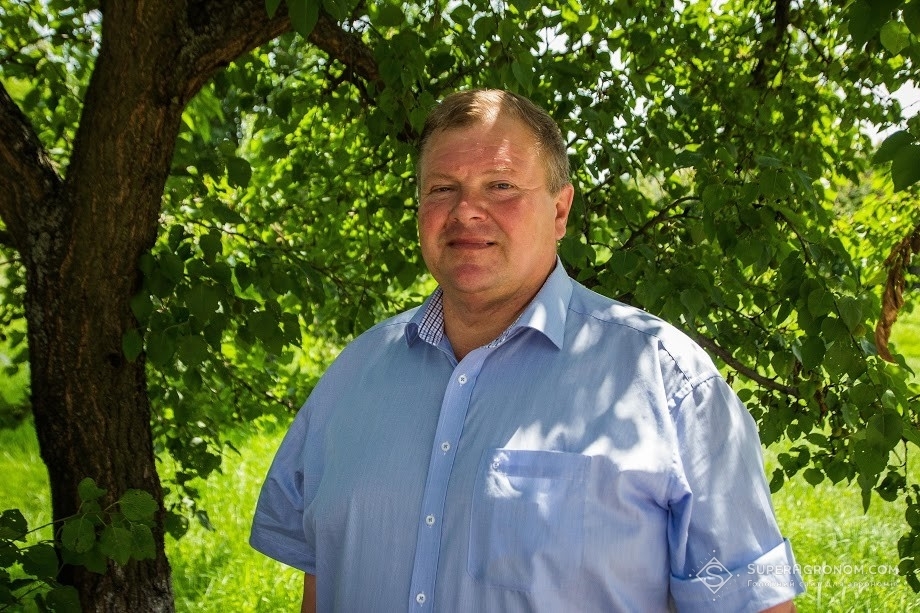
Balagura O.V. (Director of Shevchenkivske State Agricultural Enterprise)
Yes, of course, the main wealth of the farm is its people. These include machinists, milkmaids, and other animal husbandry operators, drivers, general workers, accounting staff, as well as a strong team of professional specialists, led by Oleg Viktorovych Balagura – a leader who is not just competent, but truly talented.
After graduating from the Uman Agricultural Institute, since March 1, 1984, he has been serving as the senior agronomist-seed grower at the farm.
Since January 1986, he has worked as an agronomist at the Denykhivka division, later taking the position of manager of the Denykhivka division.
Since November 1994, he has been performing the duties of the director of the farm.
Since January 1, 1995, he has held the position of Director of the state enterprise "Research Farm 'Shevchenkivske'."
In 1998, Oleg Viktorovych was awarded the honorary title of "Honored Worker of Agriculture of Ukraine."
In 2000, he was awarded the Order of Merit of the III degree, received a letter of appreciation from the Kyiv Regional State Administration, and was honored with a certificate of merit.
In 2007, he was awarded a certificate of the Verkhovna Rada of Ukraine "For Services to the Ukrainian People" and received the Order of Merit, II degree.
In 2010, he received a letter of gratitude from the Minister of Agrarian Policy of Ukraine.
In 2011, he was awarded the title "For Services to the Tetiyiv District." He holds a Doctor of Agricultural Sciences degree and is currently a deputy of the Kyiv Regional Council.
